Whatever Hurts My Brother Hurts Me
The Short and Tragic Life of Robert Peace“Whatever Hurts My Brother Hurts Me” is the motto that gives St. Benedict’s Preparatory School for Boys its moral vocabulary: another person’s injury is not external to the self but a demand for solidarity. In Rob Peace’s story, the words begin as part of a carefully engineered school culture and end as a grieving community’s declaration that Rob’s loss is shared. Between those appearances, the motto becomes an unsettled measure of loyalty, anger, responsibility, and the distance between an institution’s ideals and the violent world its students must survive.
Institutional Motto and Formation
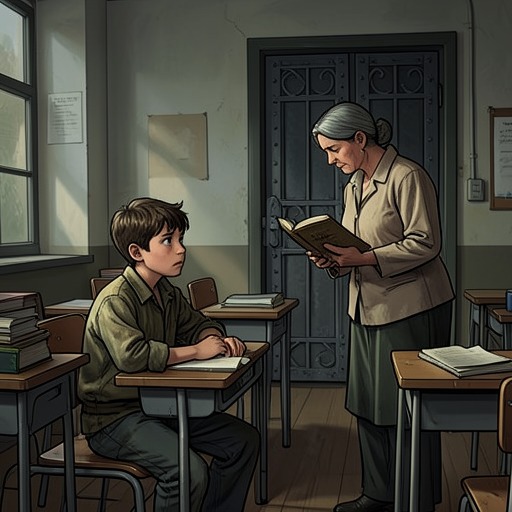
At the beginning of Rob’s freshman Summer Phase in 1994, 140 fourteen-year-old boys entered St. Benedict’s through the small vestibule on Martin Luther King Jr. Boulevard. Automated double-locked doors, controlled by a guard in a glassed-in security station, opened onto a lobby where the motto appeared in bold gray letters. The boys then moved toward the gymnasium, known as the Hive because of the school’s Gray Bee mascot. The placement of the words made them the first ethical lesson of the school’s demanding initiation: before the students had mastered the curriculum, they were asked to understand themselves as members of a collective. The incoming class came from forty towns and sixty middle schools in and around Newark. Its members represented different economic circumstances but leaned toward lower and lower-middle-class backgrounds. Some arrived already joking within small groups; others were stiff, nervous, or alone. Friar Edwin Leahy told them that they would have to build trust and unity in order to succeed at school and in life, but the motto had already supplied the compressed version of that argument. The boys were not merely entering a school; they were entering an arrangement in which each person’s conduct would affect the group and each member would become responsible for more than his private ambitions. Summer Phase converted that principle into routine. The students were divided into eighteen color groups, with eight boys assigned to each, and Rob was placed in maroon. They attended full academic days, played sports, completed evening activities, slept together in the unrenovated gym, and performed ordinary tasks such as eating and brushing their teeth within their color groups. They had to learn every classmate’s first and last name before the end of the week, memorize five school songs, and pass a test listing the names and dates of every headmaster in St. Benedict’s 126-year history. Their belongings remained exposed because locks were forbidden inside the school. The result was a system of repetition, surveillance, and shared vulnerability designed to make loyalty habitual rather than abstract. The motto’s practical meaning was therefore both generous and controlling. Memorizing names and songs fostered discipline and loyalty; color assignments obstructed the formation of independent cliques; unsecured belongings required trust; and sleeping together created a sense of family. Beneath these visible exercises lay the school’s preventative purpose. Friar Edwin Leahy and the Benedictine monks knew that many of their predominantly urban students faced fights, theft, drugs, emotional abuse, negative attitudes, and the risk of dropping out. Keeping the boys intensely busy and saturating their days with school pride was meant to keep trouble from taking hold. “Whatever Hurts My Brother Hurts Me” named the community that this structure was trying to manufacture.
From School Principle to Social Test
The motto’s force is tested whenever Rob encounters a situation in which another person’s behavior threatens his dignity. At Yale University, he worked five nights a week in a dining hall. One night, several crew-team students associated with wealthy backgrounds and elite New England boarding schools left without carrying their trays to the nearby window. They also left a crumby, puddled table, failed to thank the workers, and apparently did not realize that Rob was a student rather than a member of the service staff. Rob had asked them courteously to take care of their trays, but they ignored him. The encounter produced an anger disproportionate to the apparent slight only if the incident is treated as a matter of etiquette. Rob experienced it as a concentrated display of class power: the students’ avoidance of eye contact and smirks, their preppy clothes, the wasted food, and the assumption that his labor could be left for someone else. In the dish room he put his fist through a wall, swelling three knuckles. He then imagined finding the men away from Yale’s faculty overseers, emergency phones, and campus police and making them answer for what they had done. His rage extended the motto into a harsher register. If an injury to one member of a community was supposed to implicate everyone, then indifference to the people cleaning the dining hall exposed the moral failure of the privileged students who treated them as invisible. Rob’s response also reveals the motto’s ambiguity. St. Benedict’s had sought to prevent violence by binding students into disciplined fellowship, but Rob interpreted disrespect through a world in which accountability could become physical retribution. He described “curbing” as pinning someone facedown, stomping the backs of the head, and hearing teeth separate from the gums. The narrator could recognize the anger without equating the careless tray encounter with the violence Rob imagined. Rob, in turn, understood that his friend could not fully enter the struggle rooted in his Newark childhood. The motto promised shared pain, but the scene shows how unevenly pain is perceived across class and racial experience. That divide deepened in Rob’s relationship with Yale. He could excel in chemistry and move through elite institutions, yet he retained a fierce disdain for Yale and Yalies when he believed their privilege insulated them from consequences. His anger was not simply a rejection of education; it was a demand that education not erase the people and injuries from which he had come. The motto’s brotherhood thus stretches beyond St. Benedict’s and becomes a challenge to any institution that claims community while allowing some members to remain unseen.
Family, Injury, and the Burden of Defense
The principle also governs Rob’s attachment to his father, Skeet Douglas. During Rob’s four-hour biography at the Elihu society house, he spoke at length about a part of his life the society had scarcely heard: his father. He described his mother’s strategy of caring for him, nights spent doing homework, wandering through the neighborhood, the Pierson Street fire, the apartment on Chestnut Street, Skeet’s wide orbit of men, the murder trial, prison visits, a successful appeal, its reversal, and the letters Rob continued to send monthly to appellate judges. Rob presented Skeet as a great man wronged by a system designed against people like him. He argued that the gun used to kill Charlene and Estella Moore had been stolen from Skeet’s apartment, used in the neighboring apartment, and returned before police illegally removed it and planted it on him. The evidence available to the society did not resolve all the gaps in Rob’s account; even Arthur Turpin recognized that Rob could not say where Skeet had been on the morning of the murders. Yet the emotional logic was clear. Rob experienced his father’s conviction as an injury to his family and to the broader community represented by his father. The motto’s grammar transformed filial loyalty into a lifelong obligation to defend the wounded brother, even when that defense demanded years of legal effort and emotional risk. That obligation continued as Skeet developed brain cancer in prison. On August 16, 2006, Rob learned that the final appeal had been denied. Six days later, Skeet became unconscious; that same night his respiratory system failed, and he died quietly in his sleep, less than a month before his sixtieth birthday. Rob handled the funeral arrangements. At Rosedale Cemetery, he stood with Jackie Peace while the coffin was lowered, his bowed body supporting his mother as she confronted the decisions being buried with Skeet. Each dropped a lily into the grave. In this scene, the motto is no longer a school exercise or an argument about social respect. It becomes the silent structure of care: Rob bears the practical and emotional weight of a loss that he believes the family and the justice system have imposed upon him.
Teaching, Contradiction, and Return
When Rob returned to St. Benedict’s as a teacher, the motto accompanied him into a changed Newark. The school’s uniforms were now white and gray because students could not wear red, blue, or yellow amid the flourishing of gang culture. Rob believed the neighborhood had grown harder even as the students themselves seemed softer. He spoke to them in the weight room, on bus rides, and in tutoring sessions about “Newark-proofing” themselves: living in the hood, respecting the hood, but not becoming part of it. The school could no longer control students’ time as completely as it had during Rob’s own education. Parents were less willing to surrender their children to the institution’s philosophy, so teachers had to influence minds rather than organize every hour. Rob repeatedly warned students not to use drugs, associate with people involved in drugs, or treat the drug economy as a game. His authority was compromised by his own history, which he did not acknowledge to the students, but that history also gave his warning a particular weight. The motto demanded that he protect younger boys from harms he had known firsthand, even while his own life remained entangled with the world he told them to avoid. Rob’s teaching career followed his decision to leave drug dealing after a supplier pulled a revolver on him during a failed negotiation in August 2003. He had threatened to walk away, paid several hundred additional dollars when the supplier demanded it, and then began teaching high school. The threat reduced his accumulated knowledge and accomplishments to a single visceral awareness of the weapon’s muzzle. His withdrawal from dealing was therefore not a clean moral conversion but a consequence of fear, exhaustion, and proximity to the violence that had already marked his family and neighborhood. The motto’s ethic of protection could coexist with danger, hypocrisy, and incomplete escape.
Public Mourning and the Motto’s Afterlife
The words returned most powerfully after Rob’s death. In a public online discussion, one writer defended him against simplified accounts of drugs and fast money by recalling that he had been raised by Jackie Peace, whose kitchen work supported the family; that his father had been imprisoned; that Rob had tried to free Skeet when Skeet was terminally ill; and that Rob had inspired young men, taught them to swim, and made chemistry accessible to them. The writer knew Rob as a water-polo coach who pushed and cared for his students and mourned that he had died alone. The post ended with “WHATEVER HURTS MY BROTHER HURTS ME,” followed by the declaration that another Gray Bee had been lost too soon. The same discussion contained a competing judgment that reduced Rob to a drug-dealing character and a thug. The motto does not erase that conflict; it explains why the conflict matters. To those who knew Rob through education, coaching, friendship, or family, his death injured a network of people who had received something from him. To others, his illegal activity became the decisive fact. The phrase insists that neither account can be detached from the people who endured the consequences. It resists the idea that Rob can be made into a single anecdote about criminality, just as it resists the comforting claim that his intelligence and generosity cancel the harms associated with his choices. Repeated beneath the St. Benedict’s sign, carried into Rob’s teaching, and spoken again in public grief, the motto becomes a structural refrain. It begins as a method for turning vulnerable boys into a disciplined brotherhood, becomes a standard by which Rob measures class contempt and institutional injustice, and ends as a memorial obligation. Its deepest significance lies in that tension: the words promise that suffering will be shared, while Rob’s life demonstrates how unevenly communities recognize, interpret, and answer another person’s pain.